Tuesday, July 17, 2012

Roger Waters: The Wall, Part 3 (Final)


Read PART 1 HERE
Read PART 2 HERE

After building his metaphorical “wall” of isolation with events from his past, Pink is now longing to break free from his self-imposed barrier. Then the dreamy synthesizers and vocals of ‘Comfortably Numb’ start to kick in, set to an equally dreamy animation of a wall slowly rotating and spiraling. During this song, Roger goes about the stage singing the majority of the vocals — while facing the wall. During the chorus in which Gilmour sang on the album version, a fellow by the name of Robbie Wyckoff sang in Gilmour’s place from atop the wall.In addition, the tour guitarist played on a platform overlooking the crowd. During the outro guitar solo, the scenery changed as Roger pounded on the wall, with animated bricks collapsing to give way to several pillars.

The sun came up behind the pillars, while a small choir provided backup for Robbie to sing ‘The Show Must Go On’, portraying Pink unsure of himself as he prepares to take the stage — in a surprising way for those unfamiliar to the album.

Once again, the familiar opening chords of the first ‘In The Flesh’ blared out, resounding through the arena, as this time, a giant inflatable pig was released, branded with graffiti and mishmash. Roger, now clad in a Nazi-esque uniform, sings what seem to be the same lyrics as the first installment, but soon taking a dark twist — “Pink isn’t well, he’s back at the hotel”, meaning Pink is still not in his normal state of mind, something to consider once he “commands” the audience to put “queers”, “coons”, “Jews”, and funnily enough, pot smokers, up against the wall. After the song’s last line, he pulls out a submachine gun from out of nowhere and starts firing into the crowd! — although there were no real bullets, just the sound effects.

Next, Roger dedicated this song to the paranoids — ‘Run Like Hell’ — as spotlights scanned the arena repeatedly as several things appeared on the wall over the course of the song. Among these were a darker twist to the iPod marketing scheme — iLead, iProtect, iFollow, and soon, iPay, shown next to a gravestone; as well as one of the final lines of George Orwell’s 1984:
“But it was all right, everything was all right, the struggle was finished. He had won the victory over himself. He loved Big Brother.”
Basically, amidst his insanity, Pink has ironically turned into a figure similar to Adolf Hitler, the indirect cause of one of the first “bricks” in his wall… his father’s death in combat.

‘Waiting For The Worms’ then plays, as the background displayed several worms squirming in between the columns. After the soft verses, Roger pulls out a megaphone and starts ordering the people to carry out his “final solution”. His words soon turned into ramblings, as the crowd chant of “Hammer!” became increasingly louder, set to the iconic “marching hammers” animation from the film, until Roger screams ‘STOP!’ coming to a realization that he only has himself to blame for his wall, not the actions of others.

Then, the trippy kangaroo court scene of ‘The Trial’ begins to unfold, with Roger doing the voices of various characters, including the showman-like prosecutor, the stern and imposing judge, as well as his schoolmaster, his wife (with a strong accent!), and his mother. The judge’s sentence: “to be exposed before your [Pink’s] peers”. His command? “Tear down the wall!” The crowd soon joined in the chant of “Tear down the wall!” as a montage of scenes from the previous two hours began playing.

And then an explosion interrupted the climactic point of the set, as the wall actually came topping down, along with the release of red confetti.

Everything was silent for about a minute, until the strains of a mandolin became audible, starting ‘Outside the Wall’, with Roger remarking at the end, “Isn’t this where we came in?” The rest of the band joined him after a few minutes to make their bows and exit the stage.

I thought that this was more than just a “concert”. Heck, I don’t think you can even say that this was an ordinary concert. It was more of a spectacle — a well-orchestrated musical with awesome special effects and even the inclusion of off-stage props like the giant inflatables or the scale-model airplane. Roger didn’t need to interact with the audience that much. Rather, he let his works speak for themselves.

(10/10)

Monday, July 16, 2012

Roger Waters: The Wall, Part 2

 Read Part 1 HERE


We’re now at the point of the storyline where Pink slowly begins his downward spiral into isolation from the outside world. Along with earlier events and factors, like his father’s death in combat or his mother’s overprotective tendencies, some of the notable points here were the final “bricks in the wall” of self-imposed isolation.

The blues-rock style guitars started off ‘Young Lust’, remarkably more rock-and-roll sounding than any other song on the album. Here, Pink’s fame and fortune has brought on the inevitable craving for women and coitus, as clips of provocative naked women dancing were prominent in the background. The notable phone call at the end of the album version was played afterward, separate from the previous song.

Once you know what a collect call is, this call is somewhat amusing once you think about it enough.

 *random guy answers* ”Hello..?”
“Yes, a collect call for Mrs. Floyd from Mr. Floyd. Will you accept the charges from United States?”
*random guy hangs up*
“Oh, he hung up! That’s your residence, right? I wonder why he hung up? Is there supposed to be someone else there besides your wife there to answer?”
*operator tries again; random guy answers* ”Hello?”
“This is United States calling, are we reaching…”
*random guy hangs up again*
“See, he keeps hanging up! And it’s a man answering!”

Then, ‘One Of My Turns’ quietly starts off with a soft synthesizer drone at the beginning, along with dialogue between Pink and a groupie inside Pink’s vast apartment, although the background dialogue from the movie seems prominent as well. In the beginning of the song, Pink contemplates on how the love between him and his wife is slowly “turning gray”, but the sad dialogue gives way to another of Pink’s outbursts (apparently, this is only one of Pink’s “passing phases”). His actions and words are now violent in nature (“learning to fly”, as Pink put it, can be taken as jumping off the balcony), as scenes from the movie of Pink completely wrecking his apartment and possessions played in the background. In the end, the groupie is scared off, and Pink collapses into another soliloquy.

‘Don’t Leave Me Now’ is probably the most dissonant out of all the songs in the setlist, using augmented, minor seventh, and ninth chords. Even Roger’s voice quavers and oftentimes seems somewhat off pitch. Here, Pink’s conflicting emotions over his wife — loneliness and vengeance — clash, as his most sincere attempts at making amends transform into statements of violence, as in (When you know how I need you… to beat to a pulp on a Saturday night). The song ends in a drawn-out sequence of D minor and A minor chords, as it segues into ‘Another Brick In The Wall, Part 3’.

The final segment of ‘Another Brick In The Wall’ shows a deranged Pink refusing help from others, as Roger’s voice, as powerful as it already was, was accentuated by the piercing guitar chords and cymbal crashes. At this point, all of Pink’s past troubles are now “just bricks in the wall”, and the onstage wall that was only partly built at the start of the concert was one brick away from completion. The remaining gap was placed at Roger’s height, so that a small spotlight could shine on that very spot as he sang the last song before intermission.

As the rest of the instruments faded out, leaving only a quiet bass guitar, Roger sang his “goodbye” message to the outside world in — you guessed it — ‘Goodbye Cruel World’, as he placed the final brick in its gap.

When the lights were turned back on for the intermission, I was surprised but somewhat amused. (Actually, I wasn’t surprised at all.) Up near the roof of Joe Louis Arena was a huge cloud, presumably from pot smoke. Fun fact: two people in the row in front of me were actually passing around a joint, and my friends who also attended described a similar situation.

About fifteen minutes later, the quiet strains of ‘Hey You’ faded in from behind the wall. Note that the completed wall was at the height of the second balcony, and no one could see what was behind. This serves as an introduction piece to Act II, as Pink has now locked himself inside his apartment — the same one from ‘One Of My Turns’. But now, Pink begins to rethink his decision of isolating himself, as he tries to reach out to anyone — an idea reinforced in ‘Is There Anybody Out There?’, the next song.

The said song is highly instrumental, and features a quiet acoustic guitar with quieter accompaniment from the orchestra. Just one listen to the track and you’ll feel that haunting sensation of desolation coming from the melodies and overall lack of instruments or vocals or even sound effects. Note that at this point in time, everything is still going on from behind the wall, as Pink longs for someone to contact…


 …and that’s exactly what’s being implied in the next song, ‘Nobody Home’. With nothing else but a slow, bluesy piano, and later, the orchestra, as accompaniment, Pink starts listing off the few things he has left, since he’s lost nearly everything after his earlier outburst and his wife’s affair. There was a cleverly made inset of Pink’s apartment projected onto the wall, and Pink is shown with one of the only things he has left — his TV. Now, he is in an almost unconscious state, dozing off at the TV and/or doing drugs along with it.

Then, his questions become more numerous, as in the song ‘Vera’, recalling Vera Lynn, a 1940’s entertainer who provided optimism to the mainstream during World War II (I had to do some research on that one!). Pink now wonders if that optimism was in vain, recalling his father’s wartime death. However, uplifting video clips of soldiers from today’s wars in Iraq and Afghanistan being reunited with their children played in the background, kinda foreshadowing the next song.

Pink now knows that he is not alone in his thinking, as a choir of voices resound the titular phrase of ‘Bring the Boys Back Home’. The song was accompanied by a brass fanfare as well as a powerful quote, displayed on the wall in sequence as the song went on…
“Every gun made
Every warship launched
Every rocket fired
Signifies, in the final sense,
A THEFT
From those who hunger
And are not fed
Those who are cold
And not clothed.”
-Dwight D. Eisenhower
But as his past comes back to haunt him in the form of the voices of previous “bricks in the wall”: his schoolmaster, the phone call, and the groupie, he realizes that he is still deep in isolation. But all that was about to change. Among the amalgam of voices at the end of the song, I was able to make out a new voice: someone knocking on a door, then saying “Time to go!” as if it was a foreshadowing of what comes next.

Read PART 3 HERE

Thursday, July 12, 2012

Roger Waters: The Wall


(Part one of a three-part series)

A spectacle based on the album of the same title, Roger Waters’ concert event The Wall brings the 1979 album to life on stage. Presenting the entire album in its full glory, Waters portrays the story of a rock musician building — and then breaking — his metaphorical ‘wall’ of isolation. Choreographed with painstaking focus on detail, this concert event certainly does a great job at presenting the album live.

The concert opened with the wall partially built. Then, there was a short introductory scene with soldiers talking, presumably from World War II, followed by the booming opening chords of ‘In The Flesh?’. The opening and closing segments of the song were accompanied by stellar pyrotechnics and fireworks. To top it off, a model airplane on a zip line swooped in and crashed into the set at the end of the song.

The loud nature of the opening act gave in to the quieter, more drawn-out laments about life in ‘The Thin Ice’. In this song, our main character, Pink, is born, but quickly realizes that life will not be as easy as some people often say it is.

Pink quickly learns this in ‘Another Brick In The Wall, Part 1’. The song is a flashback to the days of World War II, when Pink’s father leaves for war. He is killed in combat in Anzio in 1944, only five months after Pink’s birth, analogous to the death of Roger’s own father. As the song played, images of soldiers killed in combat from past and present wars were displayed.

The song then segued into the famous helicopter intro of ‘The Happiest Days of Our Lives’. Roger’s voice, mimicking that of a stern schoolmaster, pierces the air: “You! Yes, you! Stand… still laddie!” Later in the song, a giant inflatable figure of the iconic schoolmaster caricature from the motion picture came into view from behind the wall.

 As the previous song transitioned into ‘Another Brick In The Wall, Part 2’, the onstage wall became littered with snippets of graffiti. By the second verse, a group of local schoolchildren sang along with the lyrics, albeit not in the original British accent. The solo was extended significantly, and the song ended on a striking D minor power chord.

One of the new additions to the setlist was an alternate version of Another Brick In The Wall, sang in a much calmer style than Part 2. It served as a tribute to an innocent spectator in Britain (heading to one of The Wall shows) killed due to a bad case of police brutality and mistaken identity. Waters then sent a strong message to the Joe Louis Arena crowd: you can never trust the government and the police force.

 
The audience then cheered as the light acoustic strumming of ‘Mother’ faded in. Many supplements to the portrayal of the titular mother were present, including a towering figure of the mother from the motion picture, only shown briefly but with menacing red eyes piercing the dark. In addition, a graffiti message was present on the wall: the iconic “Big Brother” line from Orwell’s 1984, with a big red ‘M’ painted over the ‘Br’ in ‘Brother’. Several sayings in red then scrolled across the wall, often in other foreign languages, depicting the mother’s will to protect and reassure Pink.

Then, the quiet notes of ‘Goodbye Blue Sky’ faded in. Although this song was actually about the Blitz — the World War II bombings of Britain — the animation that went along with the song said otherwise. Instead of bombs, red symbols were dropped out of planes — including the Christian crucifix, the Star of David, the Islamic star and crescent, the Communist hammer and sickle, and many corporate logos, including those of Shell, Mercedes, and McDonald’s.

The wall then turned black, as two flowers emerged from opposite sides of the wall, marking the beginning of ‘Empty Spaces’. The animation was identical to the movie, with the image of the two flowers violently engaging in coitus (bonus: the flowers actually look like certain reproductive parts). Roger, as Pink, then contemplates on how he could complete his metaphorical “wall”, as a real and imposing wall wraps around a city in the background.

Soon after, the wall rushes through several scenes: a flower transforming into barbed wire, a baby turning into a policeman and bashing a homeless person’s skull in, and finally, the wall demolishing a cathedral, as its bricks formed into a neon casino-like structure. ‘What Shall We Do Now?’, the original basis for ‘Empty Spaces’, is a social commentary on mankind’s materialistic tendencies, and although less obvious, it is also a foreshadowing of Pink’s growing craving for material goods.

 Read PART 2 HERE

Tuesday, July 10, 2012

E-books: A Double-Edged Approach to Education

Today, new technology is developed to replace many aspects of everyday life, often with the intention of improving current methods, making them quicker or simpler. Just one look around a metropolitan area demonstrates this. The growing need for simplicity and speed has led to various advancements over the years. This mindset has reduced communication time from months to mere seconds, and has made information accessible with just a few keystrokes.

An example of relatively new technology is the e-book. E-books, whose influence and sales have increased in the past few years, are virtual copies of a book designed to be read on all kinds of devices, including computers, smartphones, and e-readers. These e-readers, such as Amazon’s Kindle and Barnes & Noble’s Nook, are electronics exclusively designed for reading e-books and using the Internet. This novel idea has been met with both criticism and praise from all kinds of people, especially in the context of education.

Alas, technology cannot truly “replace” everything without retaining the same benefits of the original, and e-books are certainly no exception. Printed books are still an essential component of classroom education, and e-books still have many issues (e.g. practicality and cost-effectivity, accessibility, and their effect on the learning environment) preventing them from becoming widespread in schools. Despite this, e-readers still have exclusive and important benefits, like their portability and overall convenience.

In our technology-centric society, face-to-face interaction has been reduced by many of today’s new gadgets. Sure, it makes communication much quicker and research of information much easier, but it also encourages more time behind the screen of a laptop or a cell phone without true and genuine interaction. A disadvantage of online conversations (vis-a-vis personal interaction or face-to-face book discussion) is that it’s much harder to express or convey your thoughts clearly than it is in, say, a group discussion in school. I’ve contributed to forum discussions on the Internet before, and trying to come up with replies that won’t be misinterpreted is difficult.

Printed books, however, can encourage more personal discussions with others, with one primary example being a book club. Here, members actually take the time to meet each other and discuss their opinions on several aspects of the book in a manner similar to most classroom discussions. This also fosters collaborative thinking, providing several outside-the-box interpretations from a variety of opinions (which has happened in my class several times), as opposed to the commonplace views forced upon you by summary websites, such as SparkNotes. In addition, printed books can give a more “authentic” feel for the story as if it was a freshly written manuscript, which can also help readers envision what went on in the novel’s era and place themselves into the story.

Another drawback to e-books is its lack of practicality and cost-effectivity in developing or third-world settings. Even in the United States, the Amazon Kindle still costs at least USD $200 (approximately PHP 8540), and each new book often requires an additional purchase. This puts e-reader devices like the Kindle out of reach for most people in third-world settings. Additionally, the absence of both Internet access (despite the Kindle’s capability of using a wireless network) and electricity (in most areas) provide obstacles.

Let’s say that you somehow do own a Kindle but have little to no electricity access. There’s no way to access your e-books when the battery (with a typical lifespan of one to two months) finally runs out. Additionally, credit cards are often required for purchasing e-books, but nearly everyone in such environments lacks credit cards. And on top of that, let’s say you do have a credit card and can purchase e-books. But without some kind of coverage by an Internet service provider, there’s no way you could even download any of them! Without any of these three key components, such e-books are rendered either inaccessible or present for a limited amount of time. This means it will be several more years before we can truly see e-readers as the educational norm.

But even if all these factors are present, especially in developed countries like the U.S., $200 for an e-reader just doesn’t seem worth it. Not only that, but you’d have to pay nearly ten dollars for every book you have to read for school — around the same price that bookstores sell them. In many cases, rather than having each student obtain their own copy of a certain book, teachers provide the copies of novels and textbooks. But the most cost-effective alternative for many students, however, is the public library.

Public libraries offer a variety of books from all kinds of topics for checkout, all at little or no cost to you. These libraries, especially in a certain metropolitan area, are often part of a library network, in which one portable and convenient “library card” can be used to borrow from a massive collection of novels, references, periodicals, etc. from multiple facilities in surrounding areas. Even if you can’t find the exact book you want to read, it’s almost certain that you’ll find an alternative reading from a similar genre or topic. When I was preparing for competitions and tests such as the National Geographic Bee, the Brain Bee, and the ACT and SAT college admission tests, the exact reference books I wanted weren’t present, but there were several other references that still helped. Whether you’re researching a topic or just looking to relax, libraries provide a much cheaper solution.

In addition, many e-readers are slowly straying from their original purposes (reading e-books and browsing the Internet) and beginning to make other applications, such as those for Facebook, available. This demonstrates how products such as Amazon’s newly released Kindle Fire and Barnes & Noble’s Nook Tablet are slowly metamorphosing e-readers into tablet devices (e.g. the iPad), therefore losing their original purpose as electronics exclusively for reading virtual books. The additional apps would easily detract from the user’s focus, and would be like having someone trying to read a book while a TV or a computer is right in front of him or her — not just at home, but also in places like the school library. This can lead to low grades or a lack of understanding of certain topics, and in my case, has disrupted my focus several times while studying, causing unwanted results on tests.

Although e-books do have their flaws, some of their features provide ease of access and convenience. For example, many e-readers have accessibility options that make it much less strenuous to read text, such as increasing the text size or using high contrast, both especially helpful for the visually impaired. Moreover, the screen and backlight provide enough light in the dark and reduce glare when reading outside. E-readers are also much more lightweight and take up less space than printed books, eliminating the hassle of having to carry multitudes of paperbacks and textbooks that can cause unnecessary strain to the body. Additionally, one single e-reader can hold hundreds to thousands of novels, newspapers, magazines, etc. in the volume of a thin paperback, also saving several trees in the processThis way, you can still catch up on any curricular or leisurely readings anywhere — from the beach to a long car trip — a convenient aspect I have taken advantage of while traveling. And with trusted references such as Encyclopedia Britannica going out of print and becoming available exclusively on the World Wide Web, e-readers may soon see these collections going on sale as easy-access reference guides.

In conclusion, both printed books and e-books have their own unique advantages. On one hand, printed books foster face-to-face interaction and collaboration, and are still more practical and cost-effective than their alternatives. On the other hand, e-books are much more portable and convenient than printed books, and can help save the environment as well. There’s no telling what new ideas will be the next revolution in e-books, but for now, I believe that the benefits of e-readers simply cannot outweigh those of printed books.

4.30.2012

Wednesday, May 30, 2012

My GeoBee Experience: A Look into the Past and Present

I recently watched this year’s National Geographic Bee that I recorded on my DVR, inspiring me to reminisce and write about my experiences at the 2009 GeoBee, as well as my observations on this year’s competition. I can say that a lot of things about the competition have changed, but if there’s one thing that’s remained static since 2009 (and possibly throughout the entire history of the competition), it’s the contestants’ continued enthusiasm and passion about geography.

The GeoBee 2.0

Some things I immediately noticed were the new electronic displays, which replaced the previous letter cut-outs against a backlight. But the Grosvenor Auditorium wasn’t the only thing refurbished, as a new scoring system was put into effect.

This year, National Geographic did away with the long-standing two-strike rule for elimination in favor of a scoring system similar to that of the National Geographic World Championship. Questions are now worth a certain value of points, differing by round and type of question. In addition, if a contestant answers correctly, then a set amount of points is added to their score, with no deductions for wrong answers.

Sometimes, a question came with multiple clues or various views of one map, albeit with the trade-off of less points for each clue or map used. Oftentimes, they also came with a bonus question related to the answer choices, although it came with the risk of losing one point if answered incorrectly.

In total, there were fourteen rounds of questions this year, and the contestants with the two lowest scores were eliminated from the competition at the end of rounds 5, 9, 12, and 14. The two remaining contestants then square off in a championship round with five regular questions and multiple tiebreaker questions, with one point per question. If a winner is not determined by the end for the first five questions, the round goes into sudden death, with the first to answer incorrectly relegated to second place.

The Competition

The Top Ten finalists included veterans Vansh Jain of Wisconsin, Anthony Cheng of Utah, and Karthik Karnik of Massachusetts, as well as Neelam Sandhu of New Hampshire, the younger sister of another successful GeoBee finalist Milan Sandhu, among others. They endured fourteen intense rounds of questioning, demonstrating their knowledge on topics related to the habitats of a species of lemur, the origins of a traditional Indian dance, and the site of the Titanic shipwreck — all with sufficient geographical clues, of course! (I have personally known Vansh from my time at the GeoBee, as well as Milan from being teammates at the 2009 National Geographic World Championship in Mexico.)

After the dust settled, 14-year-old Rahul Nagvekar of Texas emerged victorious, claiming the grand prize: a $25,000 scholarship, a lifetime membership to the National Geographic Society, and an all-expenses paid trip to the Galapagos Islands. Vansh Jain finished second, and California’s Varun Mahadevan took third.

As a former National Geographic Bee contestant, I thought this year’s questions were slightly easier (just my opinion since the questions that stumped me in 2009 might be easier for others) than 2009’s (in which I placed 5th in the Nationals), although the championship round questions were still very tough. In addition, I thought the new system was an improvement from the previous two-strike rule, providing more opportunities that future finalists can use to their advantage.

“One and Done” at the GeoBee

I was at a disadvantage when it came to preparing for the GeoBee. My elementary school never participated in the GeoBee or any other academic competitions, and when I entered middle school, I was immediately promoted to 8th grade, making my first (and only) year in middle school the only opportunity I had to enter the competition. Realizing that I was up against tough and much more experienced competitors (I was only 11 at the time!), I made the most out of that single opportunity, ruling the Michigan State Bee and eventually reaching 5th place in the National GeoBee’s top ten. (I also made it to Team USA at the National Geographic World Championship, but we’ll save that story for another day.)

I prepared (without a coach or any assistance from the school, except for maybe registering for the GeoBee ;D) using previous national champion Andrew Wojtanik’s guide Afghanistan to Zimbabwe, containing comprehensive facts on each country (e.g. major cities, population, highest and lowest points, major industries), while also browsing through several atlases for more information on any geographical feature I came across when reading. In addition, I also watched DVDs and documentaries about various countries and perused through travel books and issues of National Geographic magazine.

However, this preparation didn’t seem like a chore at all. Instead, I viewed it as a chance to improve my knowledge on something that has fascinated me since my early days: I have been interested in globes and maps since I was two years old, and that interest, although not in use right now, still lingers inside me. 

The Fun Times…


Despite getting caught up in the pressure to strive for the best possible position at the GeoBee, I still had a lot of fun participating, especially with some of the things that happened on the side.

I can still remember how great it felt to have all that pent-up pressure released once I emerged victorious at the 2009 State Finals at Western Michigan University in Kalamazoo. Even the ride back home was an awesome moment for me at that time. Eating a celebratory vanilla ice cream cone from McDonald’s while listening to Queen and James Taylor, among others, in the car… good times.

Another one was at the Nationals an afternoon trip to a small outpost in Maryland, a half-an-hour drive from Washington, D.C. This rural section of land contained various playground staples, like tetherball, mini golf, and basketball. The workers there also served a delectable selection of comfort food. It was also here where I met for the second time Ken Jennings of Jeopardy! fame (Fun fact: he later describes me as “four-foot nothing” but “energetic” kid in his book on geography, Maphead, from my exploits on the basketball court).

I spent most of my time there besting the frustratingly hard but entertaining mini golf course, and by the time it was time to leave, I was able to sink the golf ball in two strokes or less. But when I wasn’t playing mini golf, I was hanging around some of my fellow state finalists or playing basketball with them. I definitely wasn’t the best basketball player of the bunch, but I came pretty close, or so I thought.

There was also a really entertaining trolley tour of Washington, D.C. as well! You know those double-decker tours they have in New York or San Francisco (complete with the commentary), right? Well, this comes pretty close to that level of excitement, even if you do have to stay indoors. We passed by several notable landmarks, like the Smithsonian Museum, several foreign embassies, the Marine Corps War Memorial (also known as the Iwo Jima Memorial), and even the White House! We also shared stories about our experiences in our respective states’ Finals.

Another bout of fun during my D.C. trip was the souvenir exchange the night after the National Geographic Bee. It was interesting and somewhat entertaining to look through all the trinkets each finalist had to share. For one, the finalist from West Virginia had samples of coal encased in tiny glass jars, and many others had small bits of foodstuffs relating to their local cuisine (as for me, I brought in keychains with the map of Michigan imprinted on them). Then it got to the point where mostly everyone started playing catch to distribute their souvenirs (the floor was carpet, so things wouldn’t break easily) and everything became a right mess!

And to top it off, the thrill of meeting Alex Trebek is a sensation that can probably only be topped by actually winning the National GeoBee. Seriously. How would you react if you were within a two-meter radius of undoubtedly one of the most famous people in television history? Funnily, before the preliminary rounds, I chanced upon Alex Trebek as he was about to enter the National Geographic Headquarters. When I greeted him, he responded and mistakenly asked if I was Eric Yang (who went on to become the champion that year). Maybe it was because Eric used a picture from his younger years, or because my picture in that year’s book of contestants lacked those distinctive glasses. What’s even more interesting is that he is also one of the few people to pronounce my last name correctly on the first attempt.

A Few Memorable Questions

During the school stage of the GeoBee, we were asked about the location of Appomattox Court House, the site where Robert E. Lee surrendered to the Union. Instead of responding with “Virginia”, like I should have, I answered with “North Carolina”. Although I knew at the time that Appomattox was in Virginia, I mistakenly thought of Guilford Court House, the site of a Revolutionary War battle (which the British won, by the way).

Another important question for me was my winning question at the 2009 State Finals, which asked to identify what Asian country was also known by the moniker “Land of the Morning Calm.” I correctly answered with “South Korea” while my opponent responded with “Japan”. The funny part is that I didn’t know this tidbit of trivia until the night before the competition, when my dad told me about various Asian country monikers, such as the “Land of Golden Pagodas”.

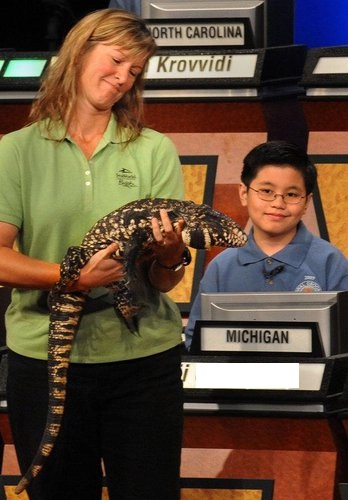
During the preliminary rounds of the national level, contestants were randomly placed into five groups and were each asked nine questions. I was one of only three contestants to answer all nine preliminary questions correctly, along with Illinois’ Siva Gangavarapu and North Carolina’s Shantan Krovvidi, if my memory serves me right. It was said that because of this, NGC had to change all the final’s questions, thus making the 2009 championship one of the hardest GeoBee finals ever.


Then there were the two questions that eliminated me from the National Geographic Bee: one asking about the site of an ancient relic on a Caribbean island (answered “Hispaniola”; correct answer was “Cuba”) and the next about identifying the city near Laguna Salada, Mexico’s lowest point (didn’t answer in time; correct answer was “Mexicali”). The Laguna Salada question lived on to become an inside joke in the family.

If only they would have asked about latitude/longitude positions of countries and cities, I might have been the champion (just kidding). But here’s a tip for future contestants: read everything on National Geographic’s website, since I was remiss on that one aspect, proving costly in the end.

Drawbacks of the Grade Level Limit

I personally believe that the ability to participate in the National Geographic Bee should be a matter of age, not grade level. Students in similar situations shouldn’t be barred from entering the Bee just because they may already be in high school at 12 years old. I would have appreciated taking the opportunities I missed because of my advanced grade level, although I probably wouldn’t have been around for this year’s Bee.

And for those saying it would be an unfair advantage for those with accelerated courses, I would have to disagree. The questions on each level of competition span a wide array of subjects that it would still be a challenge to study and master them all, no matter what level of education — even high school or higher — you’re at.

And finally…

All other thoughts aside, the National Geographic Bee has probably taken a turn for the better. This innovative system transformed the contest so that raw brainpower wouldn’t be the only thing necessary to emerge victorious. Risk-taking and sacrifices are now equally important, providing new challenges and opening new doors for future contestants.

Sunday, April 24, 2011

Witch & Wizard: The Gift


James Patterson’s Witch and Wizard: The Gift takes younger audiences on a thrill ride as he portrays the problems of corruption, autocracy, and censorship in a unique fashion. He takes elements from other bestselling books such as Nineteen Eighty-Four and Fahrenheit 451 and then combines it with characteristics from today’s fantasy novels.

The novel depicts a world closed off by the “Shadowland” and therefore has limited boundaries. Most of this “over-world” has fallen at the hands of the New Order, that seeks to create a chaos-free society. At first, that idea sounds pretty good. But the N.O. (as it’s commonly referred to by the main characters) does this at the expense of several of the things we take for granted: books, movies, art, music, and even people’s imaginations. Creativity is now frowned upon in the society. The controlled areas begin to run on an extremely systematic schedule, and the populace starts to become more machine-like and monotone.

The story is told through the points of view of two people (alternating between characters every few chapters): Whitford (Whit) and Wisteria (Wisty) Allgood, who are on the run for supposedly possessing magical powers (only Wisty really possesses said powers, which would prove useful in several parts of the story). Both are members of “The Resistance”, a rebel group based in Freeland (the area of the over-world that has not yet been conquered by the New Order) mostly made up of young adults. The two narrowly escaped execution and were able to make it back to the base unharmed.

They and the other members then attempt to plan out their next operations against the New Order, one of which includes a concert at the Stockwood Festival in order to obtain new recruits for the Resistance. But they face major problems: a spy may be inside the Resistance and another may be posing as a musician in an unrelated act. Things instantly take a turn for the worse as aforementioned band member sets a trap to fool Wisty. In the process, Whit attempts to save her, but the two other band members take him down.

Both of them are now at a special facility back in New Order territory. The spy inside the Resistance served as their guide through the facility, which turns out to be a futuristic college. It is designed to produce the next generation of workers through a special, rigorous program. Whit and Wisty instantly become used to their new environment, all the while formulating an escape plan. They were almost successful until someone spots them, and they are sent into a cold, Death Row-style room. But the spy from earlier ends up helping them! Wisty turns Whit and herself into fish through a spell, as the spy ends up flushing them down a toilet.

The two end up in a river somewhere near the Freeland border. They manage to avoid detection, even as the spell wore off and they were back to their former selves. But they were aghast as they saw what happened to the Resistance. Some members were missing, gains from earlier operations were lost, and there were little hiding places. It seemed as if all hope was lost. But they end up receiving a tip from a friend back in New Order territory. Only Whit and Wisty advance to the ally’s location while the rest agree to stay behind.

The two make it to their friend’s house and stay there for a while. However, they were unable to completely avoid detection. The One, the supreme leader of the New Order, finds them. Now it is revealed that he has magical powers as well! He controls air, earth, and water, but Wisty controls fire. There’s only one problem: Wisty hasn’t grasped full control of her “gift”, but The One uses his mastery of the other three elements in order to prevent the two from escaping. Wisty is forced to “give up” her gift to The One, and they are taken to the public execution.

But instead of a gruesome execution description, Whit and Wisty are instantly whisked off to the Shadowland, in which the spirits of the deceased roam. There, they are reunited with the spirits of their previously executed parents, and they eventually find solace there.

I found this story to be one of the few truly amazing sci-fi stories. It contains aspects from both real life and fantasy, but there’s really no over-thought sections, and there is a good balance between the two, unlike some other stories. Sure, the plot becomes hard to follow at times, but overall, this book was one of the best I’ve read so far.
- 4/24/2011 -

Sunday, January 2, 2011

Leviathan


Have you ever wondered what it would be like if the events of the past were carried out with seemingly strange concepts from the future? Scott Westerfeld does just that in his novel Leviathan, putting a whole new twist to World War I. In his book, the Great War is played out by the Allies (known as the "Darwinists", who use "fabricated" animals as their transportation), and the Central Powers (the "Clankers", who utilize futuristic machinery far more complex than today's technology). The book tells a story from two perspectives: Deryn Sharp's, a teenage girl disguised as a midshipman for the British; and Alek Ferdinand's, the runaway heir to the Austro-Hungarian throne.

Deryn Sharp, who recently suffered through her father’s death, ends up studying the Darwinists’ fabricated animals in extreme detail and pursues a career as an airman, despite being barred from serving due to her gender. She then decides to join anyway, but in disguise and under a false name, Dylan Sharp. As part of being recently admitted into the army, she was able to receive the opportunity to ride one of the fabricated animals, a “Huxley” (a giant jellyfish-like transport similar to a hot-air balloon). However, a thunderstorm brews and the wind blows her off course toward France, but the gargantuan whale airship Leviathan and its crew rescue her and take her on board.

Meanwhile, Alek Ferdinand, the son of the deceased archduke of Austria-Hungary, is on the run from his own people, who have now turned against him. With only a few crew members and a run-down "Stormwalker" (one of the Clankers ingenuous creations, controlled by body movements), he manages to slip past several German machines and scouts, including the monstrous Herkules, an 8-legged contraption the size of a military base loaded with several turrets and weapons. He uses the advice of his small but smart crew to keep low when traveling, whether he is inside the Stormwalker or outside surrounded by civilization.

The two eventually meet as the Leviathan is bombarded with enemy bombs and falls to an extremely remote location in the Swiss Alps. With absolutely no food to keep the Leviathan and its crew running, the crew members have no choice but to ride out the conditions until rescue transportation arrives. However, Deryn, while looking for civilization past the crash zone, ends up meeting Alek, who happens to be passing through that section of the Alps. At first, the two have a conflict that nearly ended up with everyone in the crash zone perishing. However, they eventually find a way to cooperate and agree to aid the Leviathan for the time being.

Alek, under the guise of a local from a village not far from the crash site, was soon interrogated by the captain of the Leviathan as well as several high-ranking crew members, and they found that despite being from one of the Clanker nations, he did not pose any threat to the Leviathan. A few days later, both Deryn and Alek were heading towards the rescue ship to bring back necessities when enemy airplanes spot the Stormwalker and open fire on it. Alek uses his quick wits to avoid being hit while taking down all of the airplanes.

After returning to the Leviathan with all of the needed supplies, the two help with the repair job, along with the rest of the crew members, and soon, the airship is fully functional and ready to go. Alek says his final goodbyes as he flees further from his enemies as Deryn and the rest of the Leviathan's crew head toward Constantinople for reasons unknown (for now).

What I enjoy the most about this book is the obscure but unique genre of steampunk. Its key characteristic is the combination of past and future. These types of novels often change the era that the event took place, the atmosphere of the event, or both. They also take place in the very world that we live in, except with fantasized elements, as demonstrated in Leviathan. As a reader formerly unfamiliar to the exact characteristics of the steampunk genre, I am very impressed with the style of this novel, as it mixes fantasy and history into the equation. Had this same storyline been used without the elements of steampunk, it would not have the power it originally delivered.